

Following the Thread - The Start of a New Art Challenge, and Why They Matter.
After taking part in many art challenges over the years, and a few weeks embarking on a new one, I thought I would share a little about the process, planning and reasons why it’s important to do.
As creatives, one of the biggest challenges when creating new work is figuring out what to create. The blank feeling of a clean sheet of paper can prevent us from getting started in the first place. Oftentimes, it’s not a lack of ideas that’s the problem, but rather having too many ideas and not a clue which one to start first!
I’ve found in the past that working to design briefs actually helps my creativity, rather than restricting it. There’s something to be said about having limitations placed on the outcomes and the process itself that lets our creative juices run free. Having boundaries allows us to push against them, try new things and experiment. Restrictions can free our creativity rather than restrict it.
But not all of us have access to creative briefs and client work, so the key is creating our own projects. Not only for our personal creative work, but also to help build our portfolios and demonstrate that we can take on client work in the future.
This is where art challenges come in. And there are so many out there to choose from! Challenges are there to give you prompts, ideas and inspiration. Look at it like marathon training. One of the famous challenges is Inktober, which actually started my obsession with art challenges in the first place. It’s run over October, and the focus is to create an ink drawing every day, following their list of prompts. It’s gained a lot of traction over the years, and there are now so many variations of this challenge that have been created by other artists and designers. There’s also the 365 project, where you create a drawing or artwork for every day of the year.
The challenge that I’m taking part in this year is the Golden Thread Challenge by the lovely art agent Jehane. The challenge is set over the year, with 4 main themes, and weekly prompts sent via email. You can sign up here. It’s free to take part, and the prompts are well thought out and very inspirational.
I’ve dabbled in this challenge over the years, but have always struggled to complete more than a couple of prompts in a year. So I knew I needed to set myself some ground rules if I wanted to succeed.
The main one is dialling in my overambitious nature to create final pieces for every prompt. I get carried away and dream up full collections with each theme, with the intention of creating portfolio-worthy designs. But unfortunately, that feels impossible to do every week, and the pressure always leads me to fall behind. And once I’m behind, it’s impossible to catch up.
So this time I’m mainly doing studies and experiments. Allowing myself to try out new techniques, brush up on observational drawing, and learning new design styles.
I’m doing this challenge alongside my usual portfolio collections, so I need to make sure I can complete the weekly prompt over the evenings, the weekend, and not interrupt my usual Friday design day too much.
So I’m having to learn the art of simplification, time management, and not procrastinating!
As I’m writing this, I’m three weeks into the challenge, and I thought it would be interesting to share a little about my thought process behind the past three weeks.
The first theme of the year is Scandi Style, which is both inspiring and a little terrifying. It feels very different from my usual design style, and now that I want to push my designs into more of an impressionist style, focusing on light and shadow, I was worried how that could merge with the simplicity of Scandi style.
But again, this is part of the fun with art challenges! It allows us to go outside of our comfort zone and do a little problem-solving. It’s always fun to see how other artists respond to the same prompt, and it really does show the breadth of styles and interpretations.
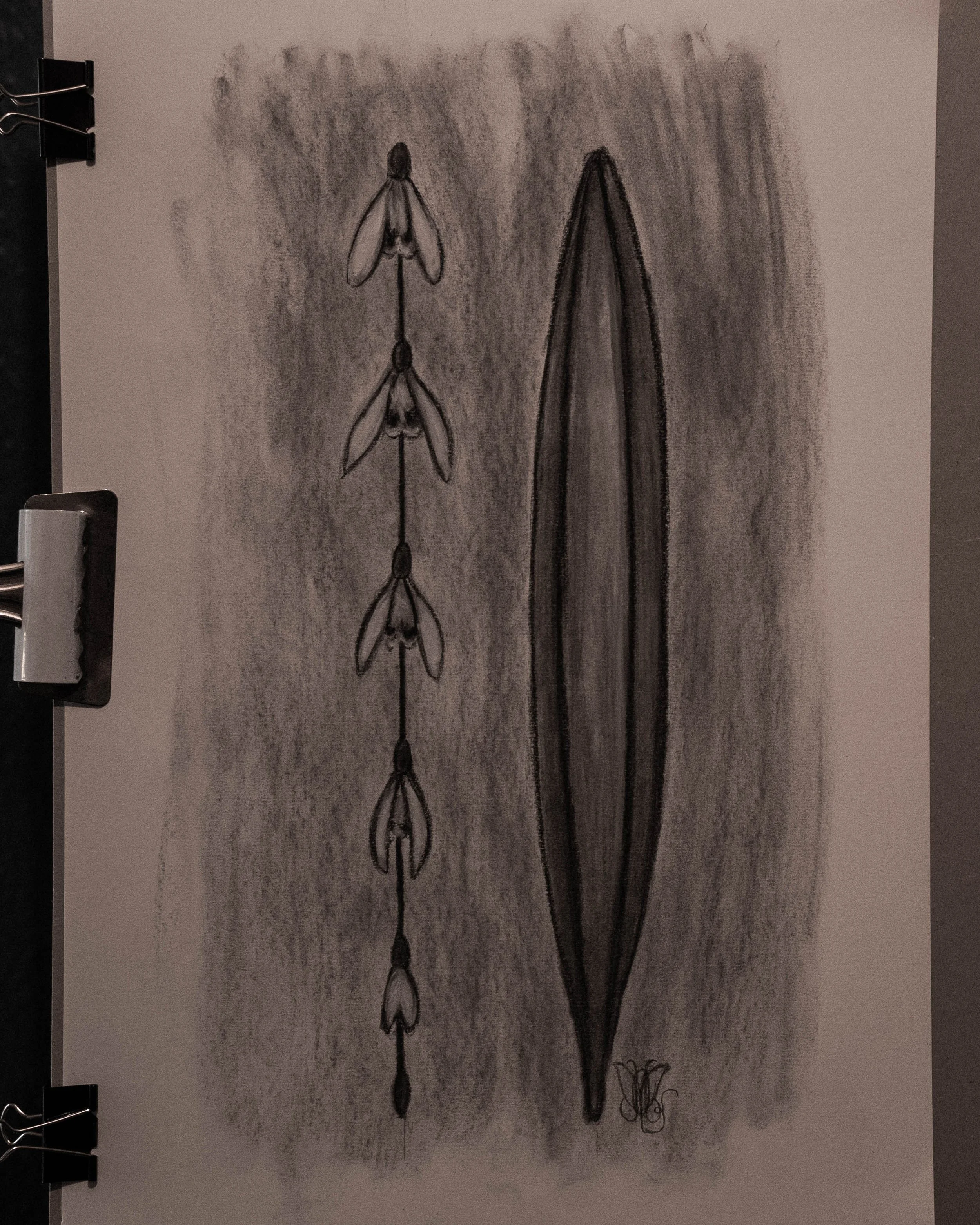
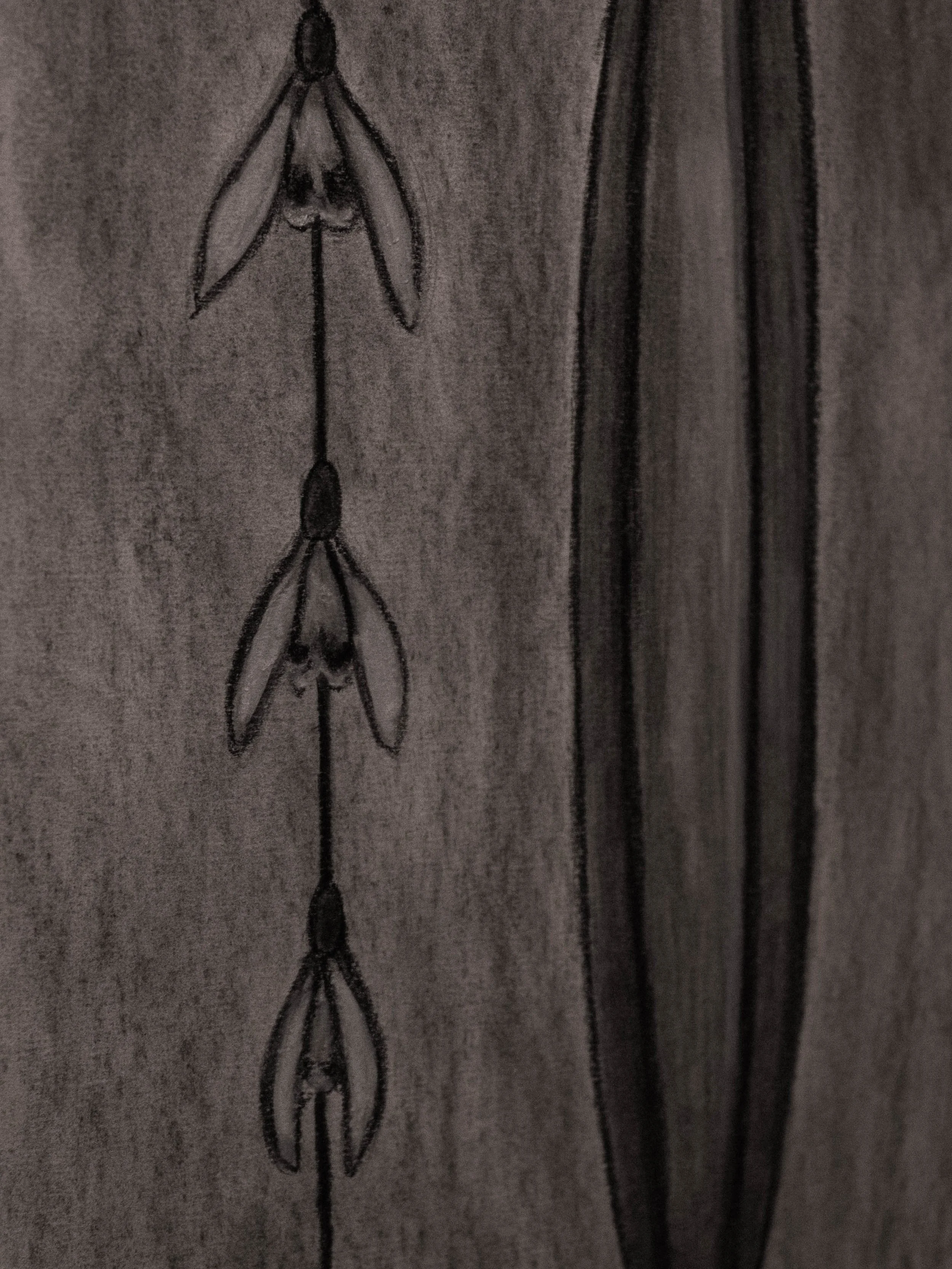
The first prompt was Turi Gramstad, a designer most famous for her work for Figgjo. Her detailed and delicate ink drawings inspired me to create my own simplistic floral design. In particular, her vase design with a line of bell-like flowers alternating with a simple leaf was the main inspiration behind my own drawing. I decided to draw snowdrops, as it’s a very seasonal appropriate flower for this time of year, and also one of my favourites to draw. Their delicately shaped flowers also lent themselves very nicely to this linear pattern!
I did this study in charcoal and white pastel, and it felt like a very good start to this year's challenge!
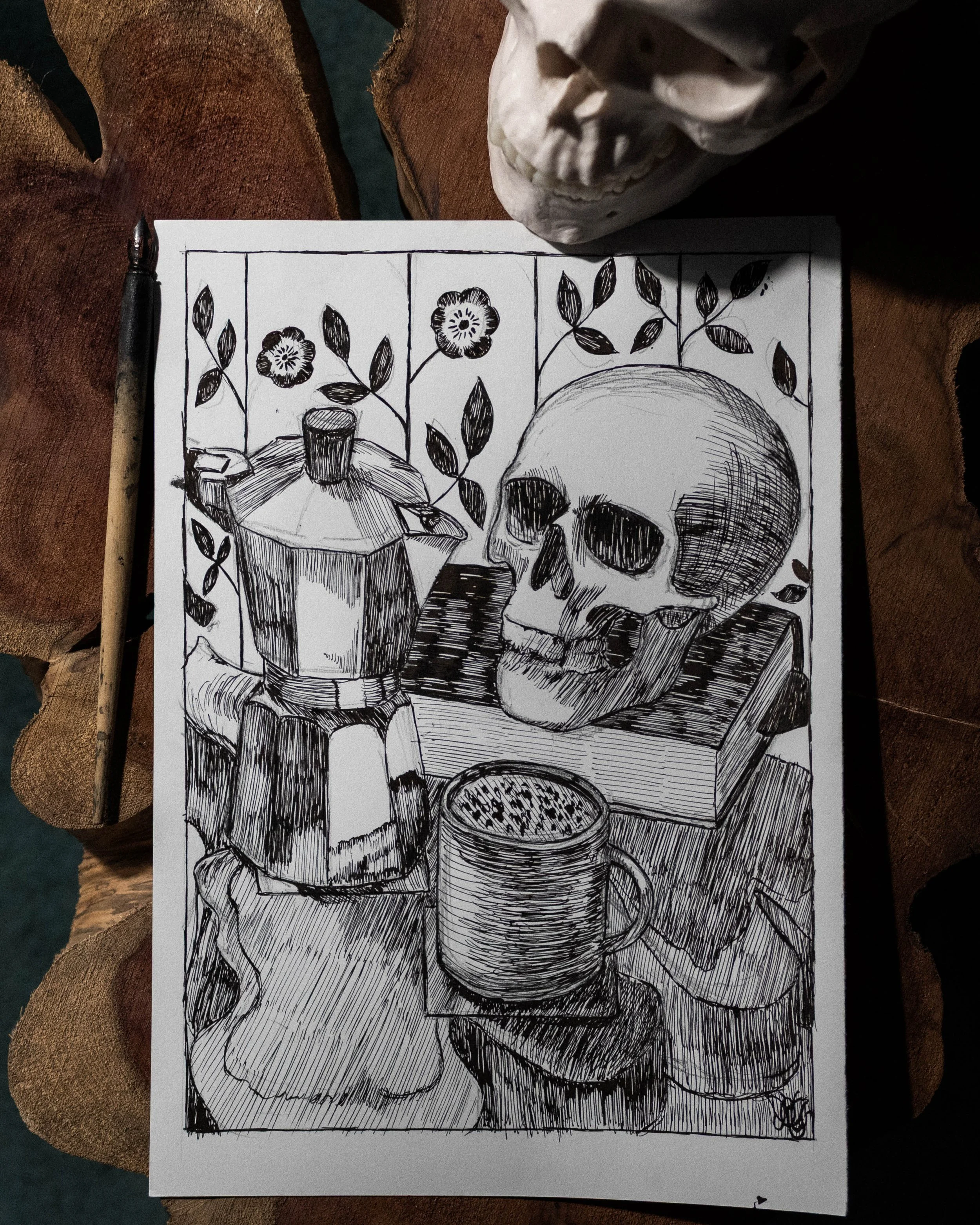
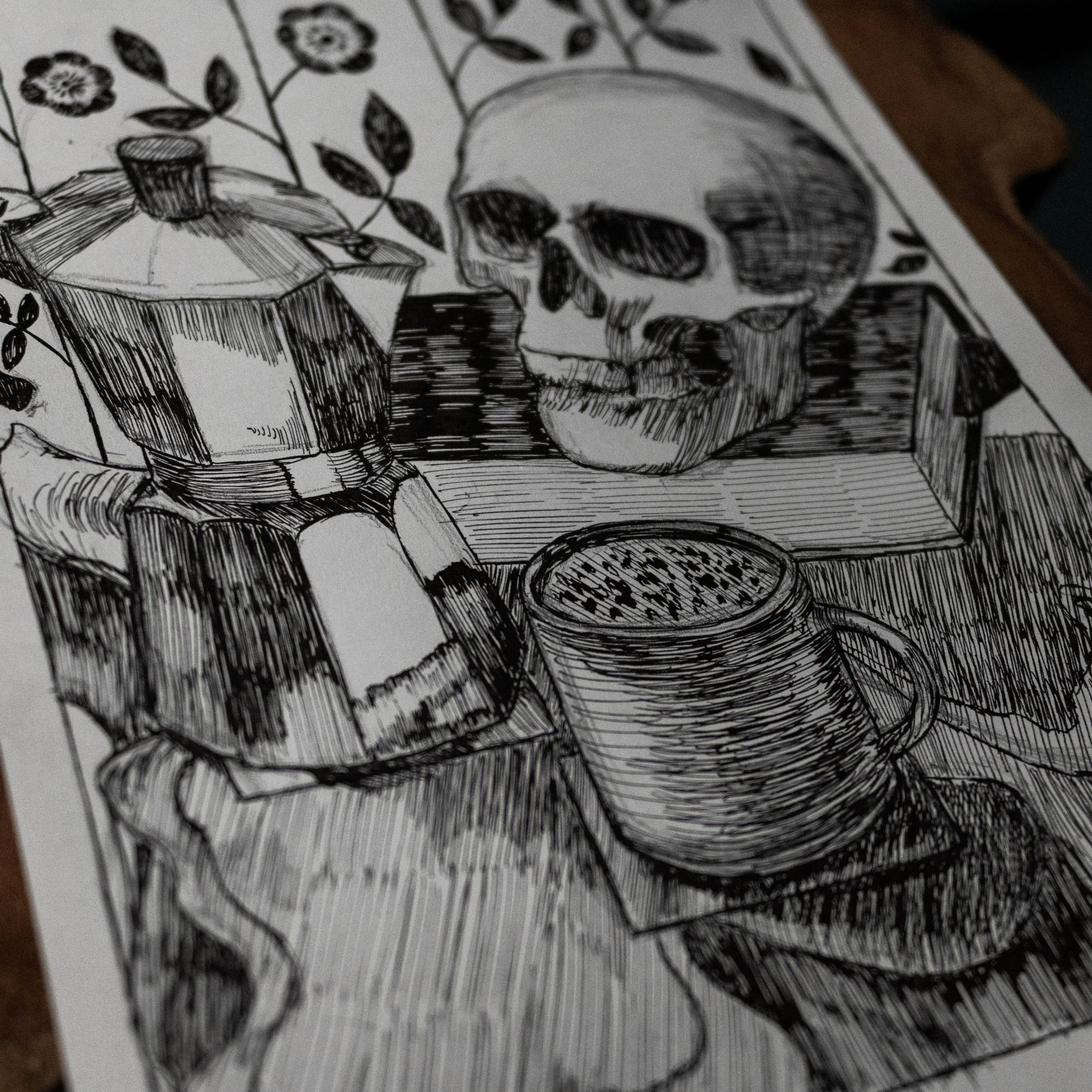
The second prompt was Fika, which was a little more challenging, as it left lots of room for different ideas. I really connected with this prompt, as it’s one of my favourite things to do and also something I want to do more of in the summer months!
Since I’ve been researching a lot about master artists, I decided to do a still life drawing with our moka coffee pot, a cappuccino, a skull (because why not) and the book I was reading at the time.
I have to admit that Edward Gorey was the background inspiration, because I’d just started reading his centennial book, and it was fresh on my mind. Which, in hindsight, did deviate from the scandi simplicity, but I did try to bring it back on topic with the scandi-inspired wallcovering in the background.
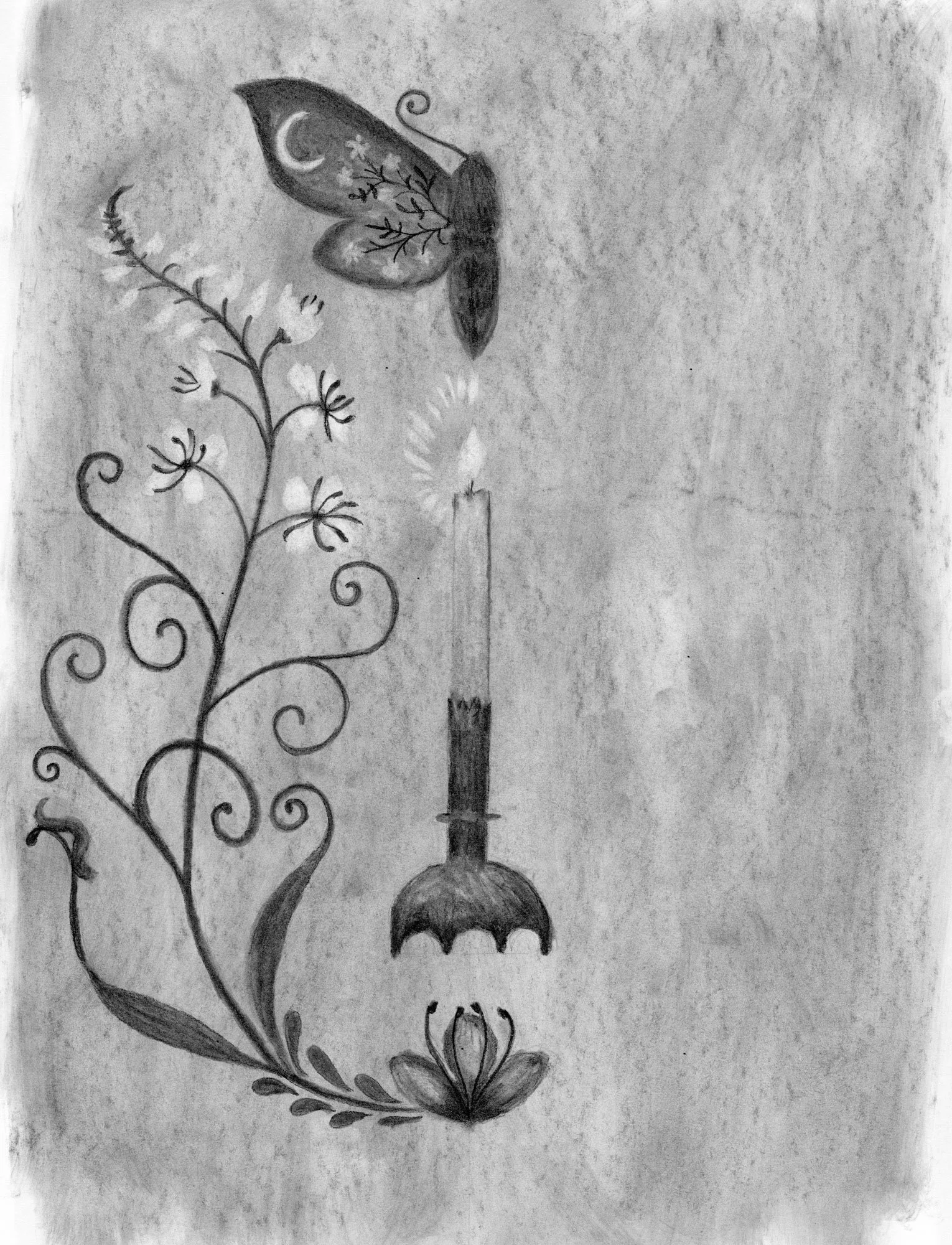
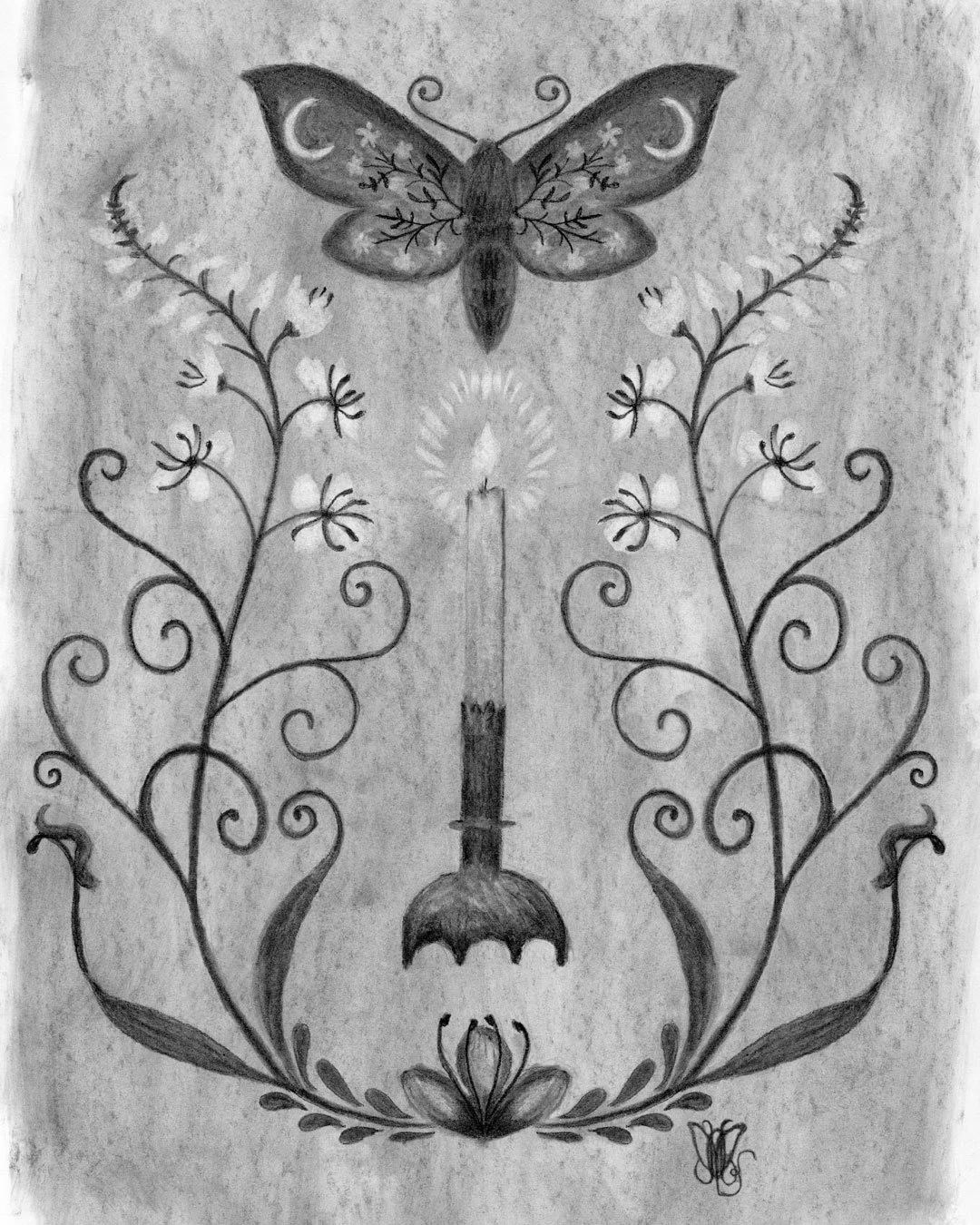
Now, for the third week, the prompt was Koselig, which has a similar feeling to the previous prompt, with plenty of room for interpretation. It left me scratching my head a little, trying to think of what I could create for it. But after a few days of pondering, this design sprang to mind.
I realised I missed a trick with last week's prompt, by not drawing tea or coffee plants, so I added them into this week's design. I centred my focus on the candle, adding warmth and cosiness, alongside an elephant hawkmoth, and a fireweed plant, which is used for Ivan Chai tea.
I’ve always admired the German artist Maria Sibylla Merian for adding caterpillars alongside butterflies and moths in her botanical illustrations, and coincidentally, the Rosebay Willowherb plant is also the plant food for the Hawkmoth!
After doing some more research into Norwegian folk art, I stumbled down the rabbit hole of Rosemaling. It is a beautiful traditional folk art which features bold brush strokes and flamboyant floral designs. Actually, relatively similar to some of William Morris’s acanthus leaves and scrolls! It’s funny how you can start to see links between different artists and their possible influences.
One of the elements I most love about folk art is its use of symmetry, which can lead to magical and pleasing designs. So I did a quick sketch of how I wanted the design to be, created a moodboard of references and started my charcoal drawing.
Because I knew this would become more of a final design, and I was planning on scanning it in, I knew I could utilise the magic of Photoshop to create the mirroring effect for me, rather than drawing both sides myself! But I still wanted the background to look like it wasn’t mirrored, so I created this rather odd-looking piece, before Photoshop helped me to bring it together.
I admit I started to play around with adding colour before realising that I was deviating from my original plan for this challenge, by not trying to create final pieces. So I abandoned that idea and settled for the simplicity of the black and white charcoal drawing instead.
Hopefully, you enjoyed a little glimpse behind the scenes of the thought process of my art challenge this year. I highly recommend taking part in an art challenge this year, whether it’s Golden Thread, Inktober, or another one that inspires your creativity. It doesn’t have to be a year-long project; even a month-long challenge can have a long-lasting impact on your creative flow. And you never know where it can lead you.
If you would like to follow along with my Golden Thread journey, you can find me on Instagram, or you can sign up for my monthly newsletter for updates.